Hit and miss: Who benefits from state
concessions and
cost-of-living support?
State and territory governments across Australia will fund around $12 billion of concessions and cost-of-living support to households this year — a patchwork of programs, built up over decades, that has become a complicated, costly and inequitable system of household support.
$12b
Concessions and cost-of-living support funded by the states this year
$1,100
Equivalent support for every Australian household
$800m
Flows to the 20% most well of households
Together, the support is equivalent to around $1,100 for every Australian household, or up to 10% of tax revenue collected by the states. In some states, the support is equivalent to all gambling revenue or up to one-third of stamp duty revenue.
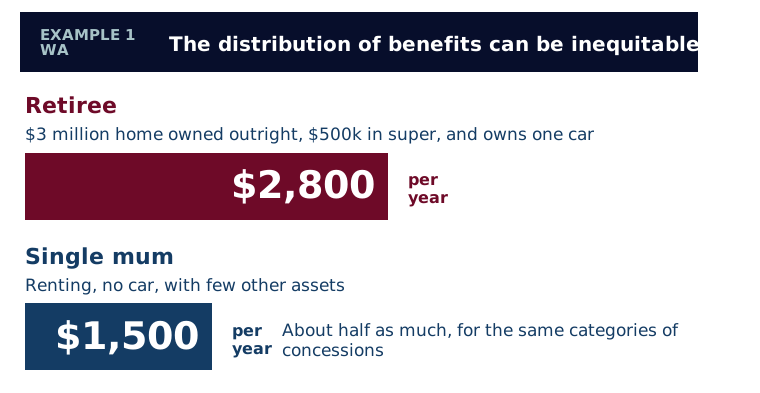
The distribution of support available differs across the country and for different cohorts. Households in larger states receive more. This year, Victorian households will receive $1,355 on average in concessions and cost-of-living support, while South Australians will receive around $370. Households that are wealthier or have a higher income can often receive more than those who have less financial capacity. A retiree with a $3 million fully paid off home, with one car and $500,000 in superannuation could be eligible for nearly $2,800 in annual concessions, while a single mum who rents and relies on public transport could be eligible for about half as much.
Figure 1 : Support from concessions is inconsistent
Source: Policy Institute Australia analysis
With state elections coming up in Victoria and NSW and cost-of-living concerns front of mind, governments may feel pressure to provide even more support. But instead of providing more, governments should look at ways to improve what they are already doing. This paper puts forward some immediate reforms that would simplify the system, and ensure support flows to those who have the greatest need.
Faulty by design
This paper considers concessions and cost-of-living support. Concessions are ongoing discounts for common household expenses such as energy bills, council rates, and public transport. Cost-of-living support is universal and one-off — such as recent car registration rebates provided in NSW and Victoria, or $100 payments in Western Australia to anyone with a driver’s licence.
A substantial share of concessions is not going to those who need it most. An estimated $800 million of state and territory concessions is going to the top 20% of Australian households by wealth, and $2.3 billion to the top 40%.
These outcomes are because of two design flaws in the concessions system. The first is that state and territory governments use Commonwealth concession cards to determine eligibility for concessions, even though these were designed for a different purpose and are often a poor proxy for financial need.
For example, a couple with an expensive home and $1 million in assets could receive a part Age Pension and be eligible for a Pensioner Concession Card. This provides access to most state and territory concessions. Some states and territories offer concessions to holders of the Commonwealth Seniors Health Card, which is only available for those too wealthy to get an Age Pension, who can have up to $5 million in assets. And states and territories offer concessions for holders of Seniors Cards, which have no income or asset test at all.
The second flaw is that concessions are often tied to consumption (such as how much energy you use) or asset ownership (such as a house or car). As more well-off households will tend to either consume more, or own more assets, more of the benefits will flow to them.
Snapshot of state and territory concessions
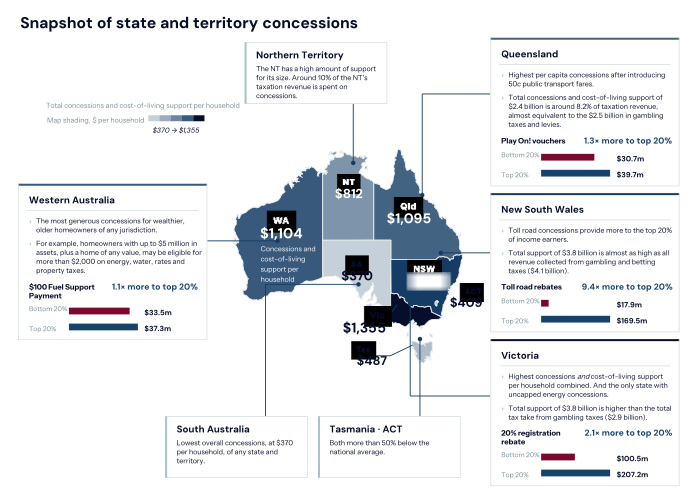
In New South Wales, the top 20% of income earners get nine times more benefit from toll road concessions than the bottom 20%.
Higher-income Australians drive more and are more likely to spend on tolls.
In Victoria, where electricity and gas concessions are designed as a percentage of a household bill, a concession cardholder who has the financial capacity to leave the heater on all winter and the air conditioning on in summer can get upwards of $2,000 a year off their utility bills. Those who cannot afford to do so will receive much less.
In almost all states and territories, property owners can get concessions on rates and property taxes that renters cannot. Across all concessions offered on rates and property taxes, the wealthiest 20% of Australian households receive more than three times the benefit of the bottom 20%.
Cost-of-living support is even more inequitable. Of the $2.7 billion of household support in response to the 2026 fuel crisis, around $700 million went to the top 20% by income and around $1.3 billion to the top 40%.
The Commonwealth fuel excise cut provided 2.4 times as many benefits to the top 20% of income-earning Australians compared to the bottom 20%, because higher-income earners drive more, and use more fuel. Victoria’s free and half-price public transport initiative provided 2.2 times more to the top 20% of income earners compared to the bottom 20%, as higher-income Victorians are more likely to use paid public transport regularly and pay full fare.
Temporary cost-of-living support often has policy objectives other than income support. In the case of the recent fuel crisis, this included reducing the economic disruption from surging fuel prices or promoting greater usage of public transport.
However, the inequitable distribution of these benefits is out of step with community expectations. Around three-quarters of Australians surveyed say they want cost-of-living support to go to either lower-income or the most vulnerable Australian households.
Targeting support to those who need it most
The Commonwealth Government is responsible for Australia’s social safety net, and has more capability and scale to provide targeted income support to households than the states and territories. This raises the question about whether states and territories should engage in this activity at all. But if state and territory governments are inclined to continue with these programs, there are opportunities to make them simpler and more targeted.
Policy Institute Australia recommends that each state and territory consolidate concessions into their own single, lump sum payment — a Cost-of-Living Allowance — targeted towards lower means households. This would be simpler for recipients to navigate, and target support where it is needed, instead of more going to those with assets or higher consumption.
If all current concession payments were allocated to households with a Pensioner Concession Card or Health Care Card, the proposed Cost-of-Living Allowance would be around $2,200 across Australia on average, and as high as $2,600 per household in Queensland and Western Australia.
A Cost-of-Living Allowance would be similar to South Australia’s existing Cost of Living Concession, which provides eligible households with cash to spend on general living expenses. States and territories could deliver this through existing digital platforms, such as Service Victoria, Service NSW, and ServiceWA.
If temporary cost-of-living support is introduced in the future, it is preferable to offer a lump sum amount, rather than a discount based on consumption or asset ownership. This would help improve the equity of distribution toward lower-income households.
Targeting of existing concession programs for older Australians can be improved by using only the Pensioner Concession Card, and phasing out eligibility based solely on the Commonwealth Seniors Health Card or a state or territory Seniors Card. Neither of these cards is a good proxy for financial need.
Finally, states and territories should work with the Commonwealth to use data held by Services Australia to better direct assistance to those in need, instead of treating everyone who holds the same concession card in the same way. New South Wales has already used Commonwealth data to target its children’s voucher program, saving over 50% while retaining the policy objective. Policy Institute Australia estimates that if state and territory governments applied a similar approach and excluded part pensioners from concessions, this would result in fiscal savings of up to an estimated $1.3 billion each year in concession programs alone.
Recommendations
Four changes to better target cost-of-living support.
01
All existing concessions should be consolidated by each state and territory into a single, lump sum Cost-of-Living Allowance targeted to lower means households for general living expenses. This would be similar to South Australia’s annual Cost of Living Concession.
02
Any future cost-of-living support should be designed as a lump sum payment targeted at those most in need.
03
Tie support for older Australians to those with a Pensioner Concession Card, and limit support to full Age Pension recipients. The Commonwealth Seniors Health Card or state and territory Seniors Cards, which are held by many wealthy retirees, should not be used to determine state concession eligibility.
04
States and territories should make use of Services Australia’s data platform to better target support to households. NSW has already used this mechanism to target its Active and Creative Kids voucher.