@ Copyright 2025
@ Copyright 2025
By Henry Williams and Indra Parta
The pessimistic scenario is accelerated de-globalisation, a recession, and higher US interest rates
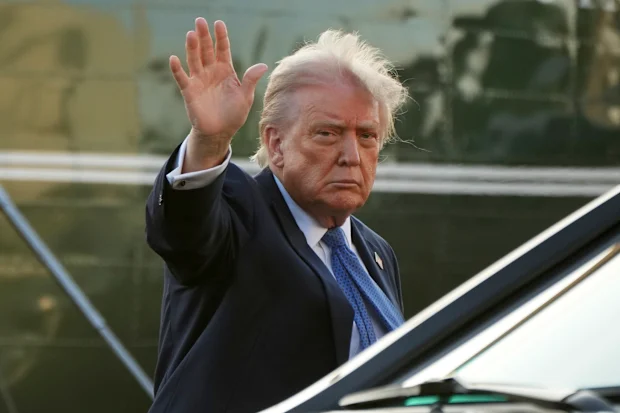
This Wednesday marks the first 100 days of President Donald Trump’s second term in office, three months of pop-up surprises. What do the next 100 days, the next 1000 days, portend?
Half the Western world’s investors and analysts, including yours truly, descended on Washington last week to find out. The IMF Spring Meetings were on, and what is normally a placid and technical affair became a hot mess of a gathering as we levelled up our understanding of this new world.
If President Trump offers the only way to change the status quo, they’ll take it. We must be clear-eyed that the issues that brought President Trump to power offer no quick fix.
After intensive downloads from experts inside and outside the White House, I offer three takeaways and three actions to consider as we face the future.
First, the tariff war [https://www.afr.com/link/follow-20180101-p5ltvz] is now a near trade embargo between China and the United States. They are not currently negotiating. There is a US deadline of early July to complete a deal, but Treasury Secretary Scott Bessent said this could be extended. Whether this is resolved in a week, a month or a year is anyone’s guess.
Second, the embargo is poised to induce at least a mild recession in the United States. But the Federal Reserve is bruised from its independence fight and will hesitate to cut rates without a systemic crisis – of which there is not yet a whiff – or a 1 percentage point increase in unemployment. Long and grinding stagflation is the consensus forecast among private-sector economists. Third is the significant risk of higher long-term US interest rates because the supply of US Treasury bonds [https://www.afr.com/link/follow-20180101-p5lsvg] is rising while demand may be soft. More bond issuance is needed to cover escalating maturities from next year plus the high deficit. The deficit (well above 5 per cent of gross domestic product since 2020) does not seem to have the president’s attention.
There is no optimism on Capitol Hill that Congress will tackle it, leaving government debt snowballing (120 per cent of GDP) and the interest bill rising past 2.4 per cent of GDP, the highest level since World War II. On the demand side, rule changes mean the Fed and major banks will soon have reduced holding requirements.
Then there is the 30 per cent of Treasury bonds held offshore, including by large trading partners who are gasping from the tariff shock and wondering if US Treasuries remain a safe haven. Falling Treasury bond demand amid growing
supply could see yields test the 5 per cent desirable ceiling. The recent depreciation of the US dollar is notable, and expected to continue despite higher yields.
Beyond the economics, the question on everyone’s mind was whether this tariff war represents negotiating tactics and next–level American opportunism, or – along with the abandonment of Ukraine – if it signals an extreme version of
American isolationism and the new world order.
The optimistic scenario sees the tariffs sorted and tax cuts rolled over, legislated in a “big, beautiful bill” in three to six months, which along with deregulation would spark a market rally, stronger growth and resettled American geostrategic leadership.
The pessimistic scenario is accelerated deglobalisation with reduced trade, reduced global financial flows and investment, and an emergence of trading blocks in a multi–polar world dominated by regional hegemons in their spheres of influence.
It is most unpleasant to contemplate the US stepping away from global leadership and free trade. But millions of Americans have chosen this path out of desperation to reverse decades of falling living standards, rising crime and shortening life expectancy. If Trump offers the only way to change the status quo, they will take it. We must be clear–eyed that the issues that brought Trump to power offer no quick fix.
As we navigate this uncertain path, not of our making and fairly beyond our control to determine, we can hope for the best but should prepare for the worst. Three sets of actions sit within our control.
First, we can take advantage of short–term opportunities. The cost of imports will fall as Chinese exporters redirect and discount their products, and a stronger Australian dollar is anti–inflationary. Our term yields have not yet risen. There is a glut of recently sacked, talented researchers and technicians in the US. It is a good time to stock up, hedge exposures, sort out funding needs and acquire talent.
Second, we should accept trade deglobalisation as reality and actively recalibrate. This means pursuing supply chain diversification, identifying vulnerabilities and war gaming disruptions. Industry policy needs development, both to offer some protection from supply price and volume shocks, and because defence budget expansion will require it. A national energy policy that delivers energy security and reliability at the lowest possible cost is essential.
Finally, Australia has a long history of leadership as a constructive middle power, a skill needed now more than ever to pursue our own national interests. It is time to double down on our efforts in this regard, act with confidence and with courage, and step up.
Amy Auster is the CEO of the Policy Institute of Australia.

There is a lot for the business community to like, but thecapital gains tax change risks penalising both passive andproductive...
Australia must strengthen its economic resilience to withstand future global shocks in an increasingly uncertain world. This requires forward-looking policy...
Across the East Coast, an admitted lawyer can’t practice without the say-so of the barristers who control the monopoly.
There is a lot for the business community to like, but thecapital gains tax change risks penalising both passive andproductive...
Australia must strengthen its economic resilience to withstand future global shocks in an increasingly uncertain world. This requires forward-looking policy...
Across the East Coast, an admitted lawyer can’t practice without the say-so of the barristers who control the monopoly.