
By Henry Williams, Indra Parta and Amy Auster
It’s easy to see how critical construction is to our economy. Across Australia, 500 new homes are completed every day. Hospitals and schools are built. The infrastructure for our energy, transport and mining sectors is delivered. Taken all together, construction activity employs 1.37 million working Australians and adds $192 billion to our economy every year.
Source: Policy Institute Australia survey of 443 large construction firms (2026). The $2.2b is a national estimate built from firms’ survey responses
But we make getting the construction job done much harder than we need to.
A plumber hired to fit out a new medical centre in Tweed Heads needs another licence to do the same job five minutes away in Coolangatta. A Melbourne builder wins a contract for work in Brisbane but has to get a new business licence first, which can take months. A fire-rated cladding system approved in Victoria has to be tested and certified all over again before it can be used in NSW, costing $25,000 and an eight-week delay. When a crew and tower crane moved from Queensland to NSW, the site stood idle for three weeks while the equipment was re-registered.
Australia is one country and one economy, but our regulatory system forces construction businesses to operate as though federation never occurred.
On paper, Australia has a single National Construction Code (NCC), the rulebook for how buildings must be built. In practice, states and territories choose their own adventure. State variations comprise 600 of the 2,000 pages in the NCC, and that doesn’t count the extra rules kept elsewhere. Today only two of the eight states and territories apply the same version of the code. Since 2022, no two jurisdictions have followed the same path of NCC adoption. Tasmania adopted the newest version, then went back to the old one a month later.
Local councils can add rules of their own. In the consultation for this paper, one builder spoke of a finished job that had to be torn down and rebuilt because a neighbouring council’s rules were slightly different, costing $80,000.
The same products can require different approvals, testing and installation rules across borders. One supplier of PVC pipe fittings adapts by absorbing the costs of separate production lines to meet different state requirements. Builders in NSW and the ACT install two versions of the same bathroom fittings because accessibility rules are interpreted differently.
Builders, architects, engineers, plumbers and electricians face similar hurdles because all are licensed state by state. An Australian licensed surgeon can work anywhere nationally, but a plumber registered in WA can’t install fire sprinklers in Victoria. Queensland registers engineers in 19 categories, Victoria in five. One firm set up a committee that met every month just to keep on top of changing state rules around its engineers’ licence requirements.
Policy Institute Australia surveyed 443 construction businesses, 387 of which work across state borders. Almost all (95%) said the differences between jurisdictions affect their business. Based on the data they shared, we estimate that the thicket of state and local regulation costs the construction industry around $2.2 billion a year. The firms we surveyed pay an average of half a million dollars a year to outside experts, purely to deal with differences between states. Four in ten lose more than 1,000 staff hours a year to it.
The bigger cost may be the work that never happens. A third of firms take on less interstate work because of the rules, and more than 20% have avoided operating in another jurisdiction. Half stick with older building methods because different rules make it harder to innovate.
Disincentive to innovate is a problem we must address, because prefabrication and modular construction hold significant potential to greatly reduce the time and cost of a build. A bathroom built in a factory costs about $10,000, compared with $25,000 on site. But factories only pay off with scale, and eight sets of rules make scale hard to reach.
Construction is our third largest employer and fourth largest industry, making it too large and important for complacency on unnecessary regulation that adds time and cost, and works against innovation, growth and competition.
Construction sector productivity (the output produced from a given amount of inputs) has been going backwards for years. This is a drag on the entire economy. We calculate that if productivity in construction had kept pace with the rest of the economy over the past 30 years, the Australian economy today would be $50 billion bigger a year, more than the entire economy of Tasmania. The average full-time worker would be $2,400 a year better off in wages. And Australia would have the capacity to build up to 100,000 more homes a year, more than enough to meet the national homebuilding target.
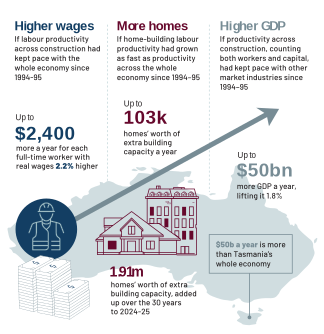
Over the past five years, economy-wide labour productivity growth would have been 1.4% rather than 0.4% if construction productivity had held flat, rather than declined.
There is no fixing Australia’s productivity problem without fixing construction.
Construction’s productivity problem has several causes, and no single reform will solve it. Challenges include workplace practices and industrial relations, slow and complex approval processes including in planning and zoning, and the small scale of the Australian market.
This report focuses on an important barrier, and one that governments can remove directly: the eight different sets of rules that disincentivise firms from pursuing productivity-enhancing technology, innovation and growth.
The Commonwealth has recognised this issue and commenced reforms toward a single national market, along with states and territories. Some changes are underway, including a review of the National Construction Code and work under National Competition Policy to progress national licences for engineers and electricians. However, to date the reform effort is framed around reducing fragmentation, not eliminating it. The risk is that the regulatory thicket is pruned, but not removed, and grows back again.
This report encourages all governments to move faster and aim higher for a truly single national market in construction.
Australia has built a single national market for banking, insurance, agriculture, food, pharmaceuticals and health care. Doctors and nurses carry one national registration. Tax agents and firms hold one national licence. Food products once approved can be sold anywhere. Banks and mortgage brokers deal with one regulator. Nobody is calling for Australia to go back to eight separate systems in those areas. Why should construction be treated differently?
We can do better, and build better.
Uniform adoption of one national building code by 2028
The Commonwealth should work with states and territories to formulate a new Intergovernmental Agreement that commits all jurisdictions to uniformly adopt the same version of the National Construction Code (NCC) by 2028, including abolishing all variations from the NCC. States should commit to legislating to prohibit local government from setting any building requirement that differs from the NCC.
Establish a National Construction Authority
National governance and regulation of the construction sector should be led by a new and properly resourced National Construction Authority, replacing the Australian Building Codes Board. The Authority should be empowered to streamline regulation and enable innovation through improvements to the NCC, including managing a new National Performance Solutions Register.
Create national licences for builders
Create a national licence for individual builders, and another for building businesses. Existing state-based licences could be grandfathered.
Create national licences for architects
Create a national licence for architects and another for architectural practices for use in jurisdictions where business registration is required. Existing state-based licences could be grandfathered.
Remove exemptions to automatic mutual recognition
Remove exemptions to automatic mutual recognition and update licence equivalence tables to support mutual recognition.
Use the National Productivity Fund to fund reform, and incentivise states and territories to act
A substantial increase in the Commonwealth’s National Productivity Fund should be announced, and used to support the proposed package of reforms. It would be used to establish the new National Construction Authority and national licences for builders and architects, compensate states and territories to abolish all variations from the NCC, prohibit any local council variations, and implement a new national approach to building products, and to commit to the package of reforms into the future.



Hit and miss: State and territory governments across Australia will fund around $12 billion of concessions and cost-of-living support to...
The fair go is quietly slipping. Australia's safety net was built on a simple idea: help should go to those...
Over the next decade, plans are to build at least $65-$85 billion in transmission lines across the east coast of...
Australia’s productivity has stalled, threatening living standards and future prosperity. This paper calls for bold reform to reignite competition the...