
By Amy Auster, Henry Williams, Indra Parta and Nicholas Tarrant
Australia’s social safety net has long reflected a simple idea: taxpayer funded support from government should go to those who need it most. That idea, grounded in our national values of fairness and equity, is quietly losing ground.
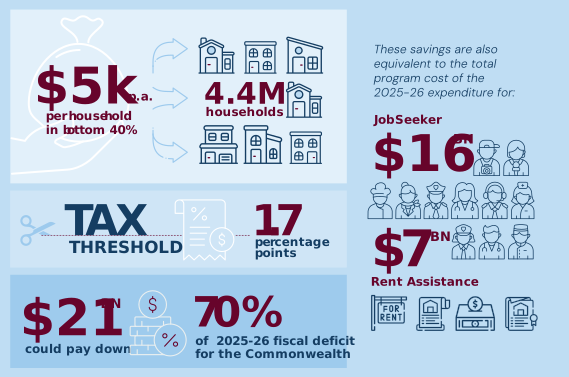
Better targeting could free up about $21 billion a year. This could fund:
“A retired couple with a $5 million home in Sydney can qualify for the full Age Pension worth almost $50,000 a year, while their renter neighbours with $1.5 million in super receive no pension at all.”
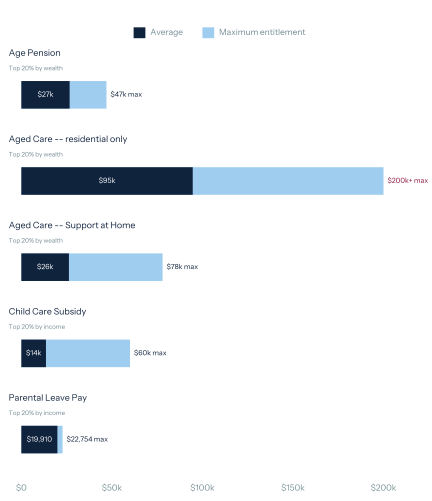
Our social safety net is growing faster than the economy, and a substantial share of this growth has flowed to Australia’s most well off households. Our safety net is becoming both more expensive, and its distribution less equitable. Today, a retired couple with a $5 million home in Sydney can qualify for the full Age Pension worth almost $50,000 a year, and up to $150,000 for one spouse in Aged Care. Their neighbours who rent a modest home and hold $1.5 million in super receive no pension at all and roughly half the Aged Care support. Just 1% of households have income too high to qualify for either the Child Care Subsidy or Parental Leave Pay; a family earning $400,000 a year may qualify for around $20,000 in Child Care Subsidy and a further $20,000 in government Parental Leave Pay.
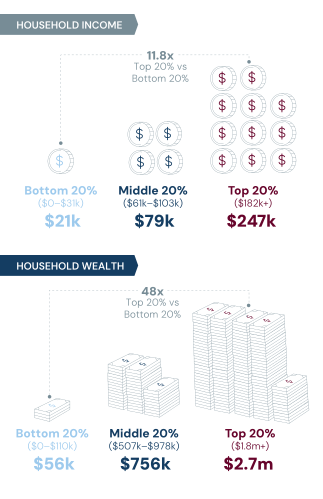
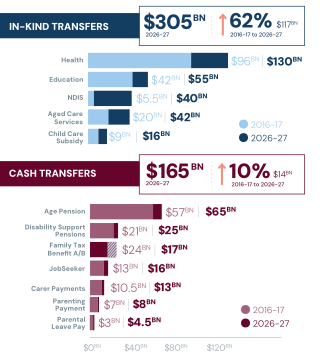
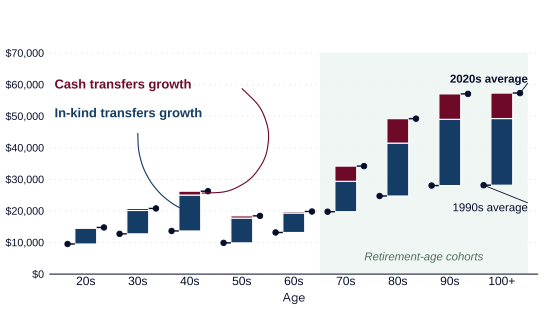
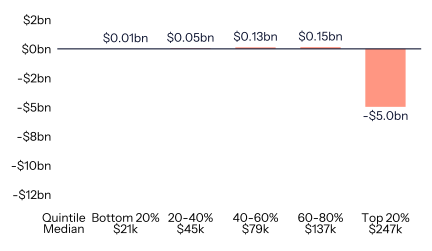
These outcomes are the predictable result of means testing rules that have not kept pace with a wealthier and older Australia. This is a concern for the fairness of our social safety net today, as well as for its sustainability in the years to come. Policy Institute Australia has crunched the numbers, and found that across four programs — the Child Care Subsidy, Parental Leave Pay, Aged Care and the Age Pension — the 20% most well off households will receive about $25.6 billion in support this financial year, or around 20% of all expenditure in these programs.
We have developed alternative and better targeted means testing arrangements. These would free up $21 billion, which could:
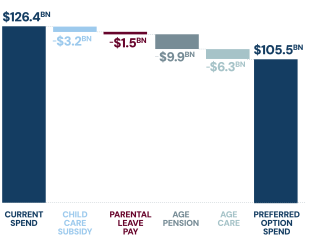
We have developed an alternative approach to means testing across four programs that improves equity by better targeting support. It builds on existing frameworks rather than replacing them, making reforms practical to implement. Built into our approach is fairer treatment of owner-occupied housing as a recognition of wealth, alongside a principled stance that the most well off Australian households have financial capacity to pay for more of the services they receive, and should do so.
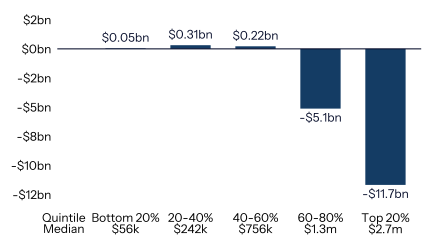
Recognising that some retired households primarily hold their wealth in their owner-occupied home, and may be unable to fund living expenses at the full pension, we have proposed a new policy: the ‘Retirement Contribution Scheme’ or ReCS. Like HECS, ReCS is an opt-in scheme that would enable retirees to defer the cost of self-funding their retirement.
“Our social compact depends on it.”
This paper is not intended to provide a definitive answer on how means testing should be designed for these programs, but rather to demonstrate there are options for a more equitable and sustainable means testing approach that could be applied to these and other programs. In doing this work, we aim to kick start a conversation on who needs what from our social supports system, and how much taxpayers should be called upon to provide, both now and into the future. Our social compact depends on it.




Over the next decade, plans are to build at least $65-$85 billion in transmission lines across the east coast of...
Australia’s productivity has stalled, threatening living standards and future prosperity. This paper calls for bold reform to reignite competition the...
Over the next decade, plans are to build at least $65-$85 billion in transmission lines across the east coast of...
Australia’s productivity has stalled, threatening living standards and future prosperity. This paper calls for bold reform to reignite competition the...