
By Amy Auster, Henry Williams and Nicholas Tarrant
Over the next decade, plans are to build at least $65-$85 billion in transmission lines across the east coast of Australia, more than tripling the value of our transmission grid. Transmission is essential for our energy transition, as renewable generation replaces our ageing coal fired power stations that are nearing the end of life.
But a $65-85 billion transmission build means the network charge on household electricity bills could rise by up to $600 a year, a 25% increase in total bills, as the investment costs are passed directly to consumers.
It’s not too late to take the steps that will minimise the cost to households and forge the path to more affordable clean energy future. To get there we need clearer accountability and responsibility in investment decisions for our transmission system, and we need to avoid repeating the mistakes that have seen huge cost blowouts on many of our largest infrastructure projects.
Over the next decade, plans are to build at least $65-$85 billion in transmission lines across the east coast of Australia – more than tripling the value of our transmission grid. Transmission is essential for our energy transition, as renewable generation replaces our ageing coal fired power stations that are nearing the end of life.
But a $65-85 billion transmission build means the network charge on household electricity bills could rise by up to $600 a year, a 25% increase in total bills, as the investment costs are passed directly to consumers.
It’s not too late to take the steps that will minimise the cost to households and forge the path to more affordable clean energy future. To get there we need clearer accountability and responsibility in investment decisions for our transmission system, and we need to avoid repeating the mistakes that have seen huge cost blowouts on many of our largest infrastructure projects.
Over the past 20 years, a transport megaproject boom has redrawn our cities. It has reduced travel times, facilitated growth, attracted investment into the civil construction industry and changed the industry itself. It has resulted in massive jobs growth, with the civil construction sector adding 50,000 more jobs over the past two decades than if it had grown at the same rate as the overall labour market.
“The average estimated cost overrun for the 10 largest transport projects along Australia’s east coast announced since 2010 has been 100%, an average of over $10 billion per project.”
It has also been very expensive. There are currently more than 50 transport packages valued at more than $1 billion each under construction across Australia. Many of these ‘megaprojects’ have ended up costing more, sometimes far more, than originally budgeted.
The scale of the transport boom has expanded the civil construction industry. Civil construction output on road and rail projects increased from $21 billion per year in the 2000s to $46 billion per year in the 2020s, with the share of GDP rising from a low of 0.6% in 2003 to a recent peak of 1.4% of GDP in 2024. Along the way, capacity challenges to deliver projects on time and on budget have persisted, particularly with regard to the civil construction labour force.
It is into this capacity constrained market that Australia is gearing up for the next megaprojects boom in energy. Australia is undergoing an energy transition, driven by the end-of-life closure of coal-fired power generators, as well as by ambitions to reduce Australia’s greenhouse gas emissions. To date, renewable energy projects have dominated the pipeline. Going forward, much larger transmission projects await.
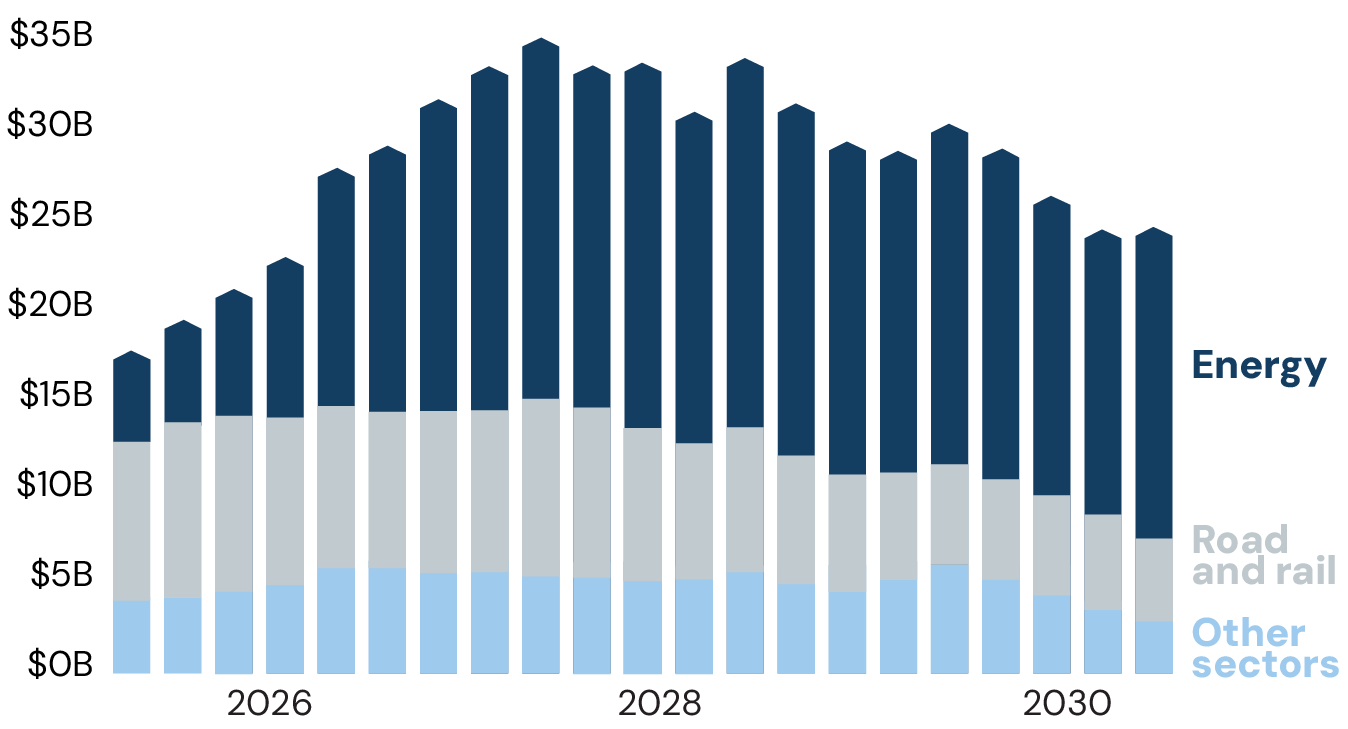
Major transmission projects, which enable the expansion of the electricity grid, dominate the pipeline of energy megaprojects. Given their size and dominance, transmission projects are the focus of this paper. Expansion of the grid is needed to connect new renewable generation to consumers as old coal-fired generation is phased out.
The investment is huge. Current plans target a 15% increase in the length of the transmission grid, at an estimated cost of at least $65 to $85 billion in capital expenditure along Australia’s National Electricity Market (NEM). Cost estimates will almost certainly rise given abundant evidence of exceedingly low initial costings on projects that have been contracted so far. Even at current estimates, this value would more than triple the total value of the current transmission regulatory asset base (RAB) in the NEM, with most investment in New South Wales, Queensland and Victoria.
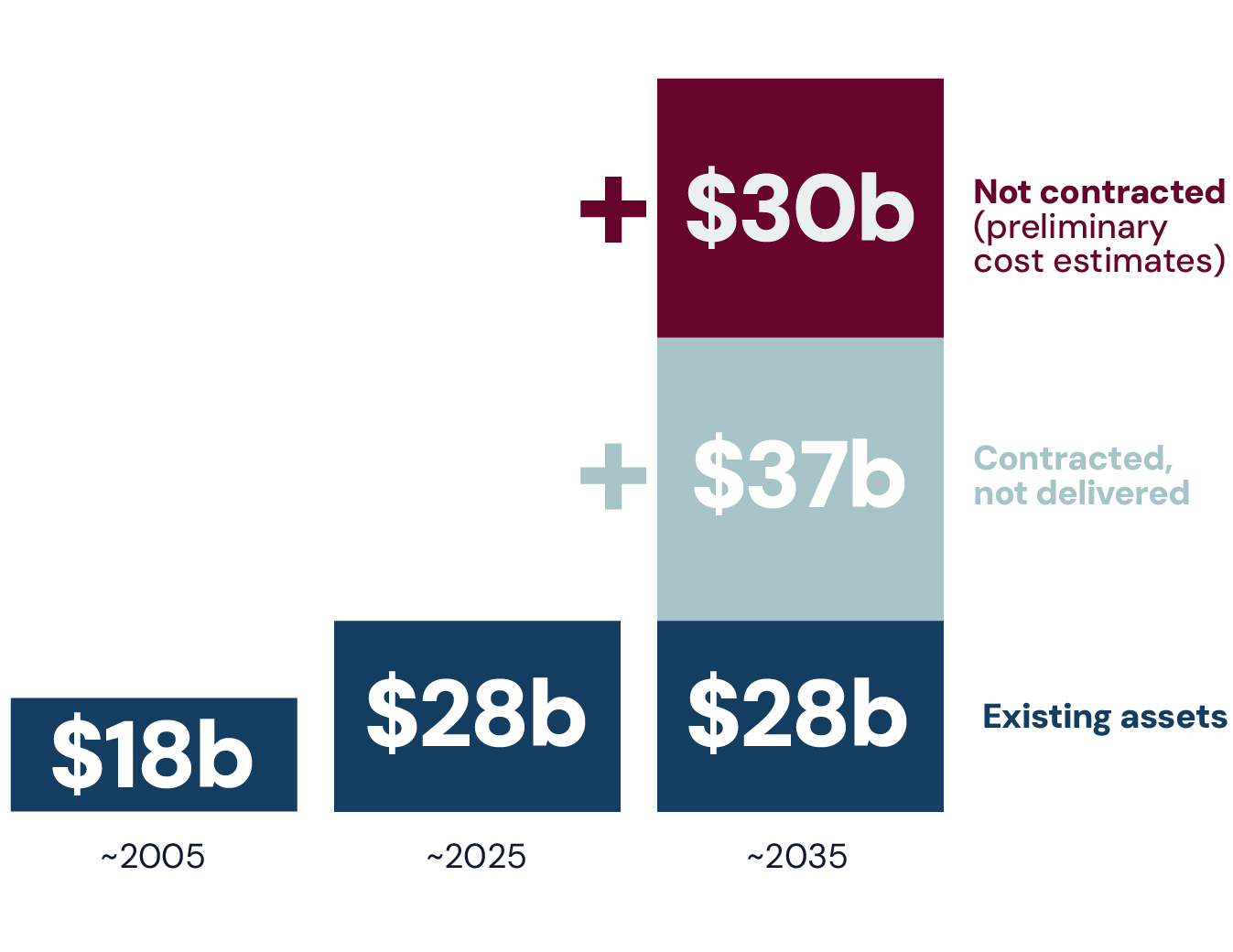
The risk of energy megaproject cost overruns is a matter of grave concern. Across the NEM, the grid is owned and run by monopoly transmission network service providers (TNSPs) who pass their investment costs on to consumers through regulated electricity network charges. This is quite different to the impact of cost overruns in road and rail, where most public investment is absorbed into government balance sheets. For decades, the well-established NEM required relatively little investment, leaving transmission charges at only around 9% of retail electricity bills.
Going forward, however, as capital costs rise and are recouped through an approved RAB, consumers’ bill for transmission will also rise. Policy Institute Australia estimates that the $65–$85 billion in forecast transmission capital expenditure could cost an east-coast Australian household up to an extra $600 each year, on average, once these projects enter the RAB. That’s equal to an increase in household energy bills of about 25%.
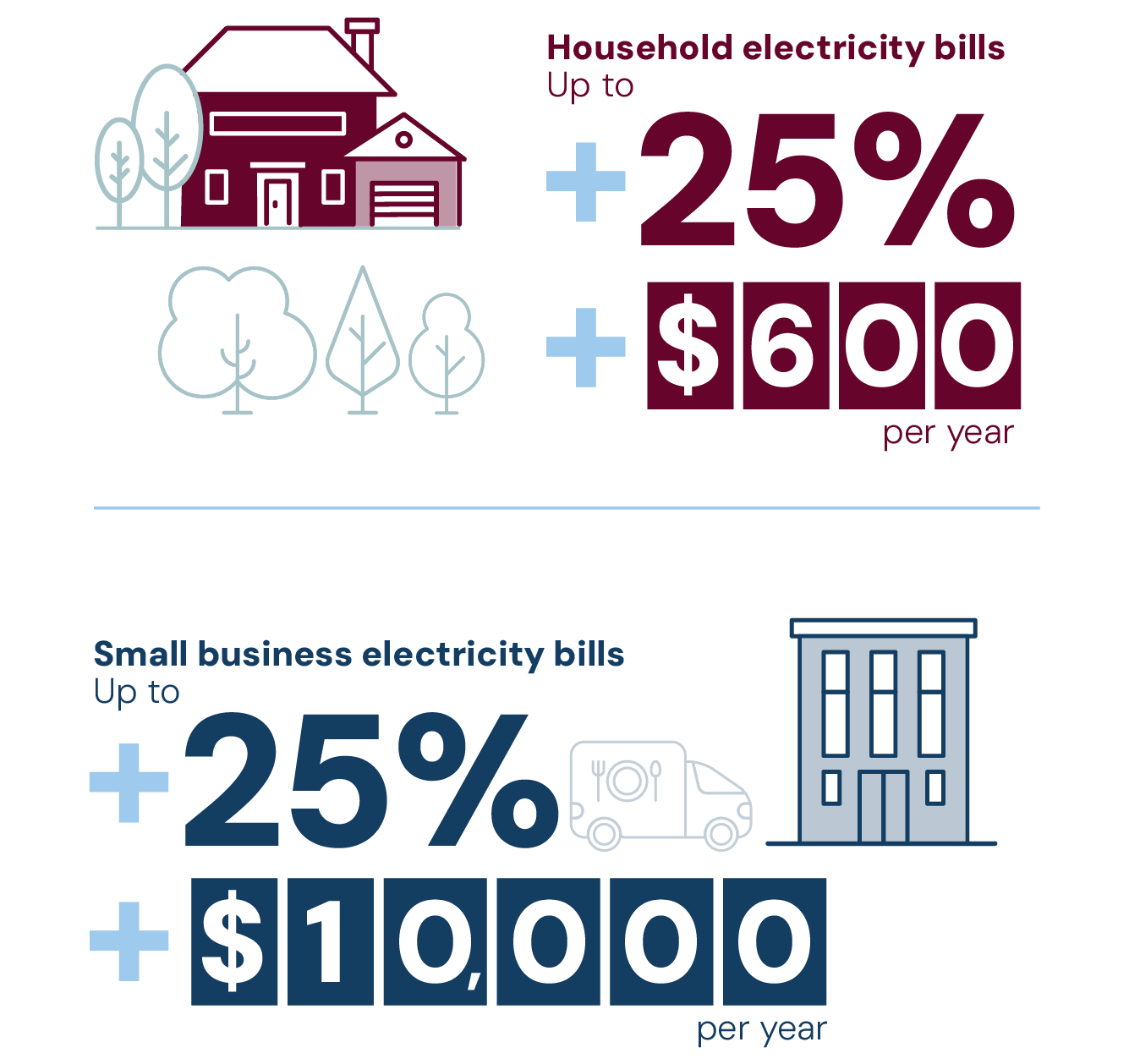
The magnitude of the increase would vary by household usage, but the increase in charge may be disproportionately borne by lower income households. For example, for a typical NSW household, a 20% increase in annual electricity costs is equivalent to 0.5% of income for a middle income household, but 1.3% of income for a lower income household.
“Costs could rise more if poor delivery sees even more cost escalation”.
Policy Institute Australia estimates that a typical small business would also see an increase in their energy bills of about 25%. For a small business with an annual consumption of up to 100,000 kWh per year, this would add around $10,000 in annual electricity costs.
At worst, lengthy project delays or failures could lead to grid instability and blackouts, at a much greater cost.
The good news is that it is early days in the transmission build. It’s not too late to intervene with reforms to contain costs and deliver our future energy system with clarity and certainty.
To illuminate the path forward, this paper examines the experience of the major transport boom and applies it to the energy sector in a “lessons learned” approach. Though transport and energy are very different sectors, the mistakes made in transport are typical of megaprojects generally, and if applied can help deliver a more affordable renewable energy future.
“At this early stage of the energy boom, warning lights are flashing bright that the mistakes of the transport past may be repeated in our energy future”
Cost drivers identified in the transport boom include weak front-end planning, poor scoping often resulting from politically-driven announcements, immature procurement and contracting approaches, limited contestability for some projects, poor recognition or management of capacity constraints, and issues in industrial relations. A rapid ramp up of the pipeline, its scale and ambition for “first of its kind” projects were also factors.
The causes of cost overruns in transport megaprojects have been structural, not incidental. They reflected incentives, institutions and market settings that were insufficient to drive disciplined investment or credible delivery.
The total expected cost of transmission investment has nearly tripled, in real terms, from $30 billion to $65–$85 billion. Costs are likely to escalate further, as many identified transmission projects are yet to be fully scoped and have a large margin of error around their cost estimates, with a high risk of future upward cost revisions as well as cost overruns.
In this paper, Policy Institute Australia sets out a pathway to improve our ability to deliver an affordable transmission transition.
First, we look at the experience of Australia’s transport boom, the track record of delivery and the market conditions that have resulted. We then review Australia’s energy transition, the role of transmission and the pipeline of energy megaprojects. Finally, we apply lessons learned in transport to energy, and provide recommendations for reform across three areas: planning and scoping, procurement and contracting, and capacity management.
“the energy transition can be delivered more efficiently and at lower cost. If not, consumers will face higher bills, slower decarbonisation and greater risk to system reliability.”
Our reform direction is practicable, grounded in the principles of competition and contestability, and aims to limit cost overruns on major project delivery. The issues we identify largely result from a need for our institutional and governance arrangements to evolve along with the changing nature of our energy system; like the energy system itself, our governance arrangements need to transition to suit a renewable energy future.
Australia has done difficult infrastructure tasks before. The country expanded road and rail networks at pace, under tight labour markets and complex planning environments. The lesson from that experience is that well-designed institutions, credible planning and competitive markets matter. The transmission build can draw on those lessons, if governments apply them consistently.
And a more dynamic, competitive and affordable approach would benefit not just the energy transition but all the other areas of the economy that are enabled by essential infrastructure and the industry that delivers it.
Australia’s productivity has stalled, threatening living standards and future prosperity. This paper calls for bold reform to reignite competition the...
Australia’s productivity has stalled, threatening living standards and future prosperity. This paper calls for bold reform to reignite competition the...